Double Head Polishing Machine - Conveyor Belt Sander for Metal Finishing
What Is a Double Head Polishing Machine?
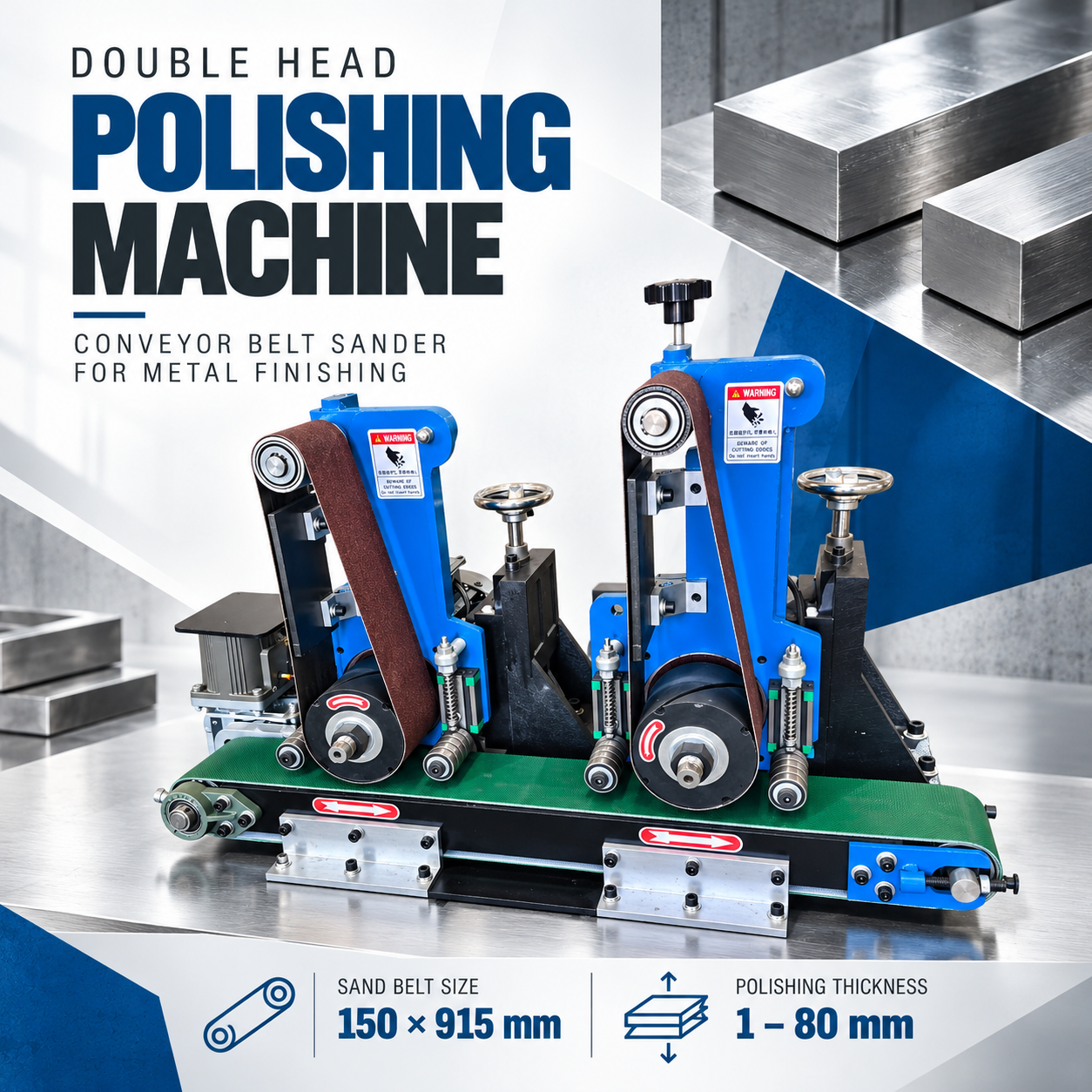
A Double Head Polishing Machine, also known as a double station conveyor belt sander, is an industrial machine designed for grinding, sanding and surface finishing of compatible metal components.
It features two polishing stations and a powered conveyor system that moves workpieces through both stations. This allows manufacturers to perform two successive finishing operations in a single machine setup, reducing material handling and improving production workflow.
For example, the first station can use a conventional abrasive belt for grinding, while the second uses a non-woven abrasive belt for surface conditioning and finishing.
How Does a Double Head Conveyor Belt Sander Work?
The machine combines two abrasive belt stations with a conveyor feeding system to process metal components in a continuous workflow.
- Workpiece loading: Place the metal component on the conveyor.
- First-stage grinding: The first abrasive belt removes surface irregularities and prepares the metal surface.
- Second-stage finishing: The component passes through the second station, where a non-woven abrasive belt can refine the surface.
- Finished component discharge: The processed component exits the machine, ready for inspection or further processing.
The final result depends on the metal type, abrasive selection, conveyor speed and machine settings.
Two-Stage Metal Finishing with Different Abrasive Belts
One of the biggest advantages of a Double Head Polishing Machine is the ability to use two different belts for successive finishing operations.
First Station: Abrasive Belt Grinding
The first station can use an aluminium oxide or zirconia abrasive belt, depending on the application, to:
- Remove selected surface imperfections.
- Smooth rough areas and prepare the metal surface.
- Perform initial grinding and material removal.
The appropriate abrasive grit depends on the workpiece material and the amount of material that needs to be removed.
Second Station: Non-Woven Belt Finishing
The second station can use a non-woven abrasive belt for surface conditioning and refinement. Its functions may include:
- Refining the surface after initial grinding.
- Reducing the appearance of coarse scratches.
- Creating a more uniform surface finish.
- Preparing components for subsequent finishing operations.
Benefits of Using Two Different Belts
- Reduced processing time: Grinding and finishing can be completed in one continuous workflow.
- Less material handling: Components do not need to be transferred between separate machines for each operation.
- Improved production flow: Two finishing stages are combined in one machine setup.
- Flexible finishing options: Each station can be configured for a different abrasive operation.
- Consistent results: Defined abrasive selections and operating settings help maintain repeatable finishing conditions.
Actual productivity depends on the workpiece, belt selection, feed speed and required finish.
Key Features of the Double Head Polishing Machine
1. Two Polishing Stations
The machine features two abrasive belt stations, each powered by a 2200 W motor. This arrangement supports successive grinding and finishing operations within a single setup.
2. Conveyor Feeding System
A dedicated 120 W motor powers the conveyor, moving components through the polishing area and helping streamline repetitive production operations.
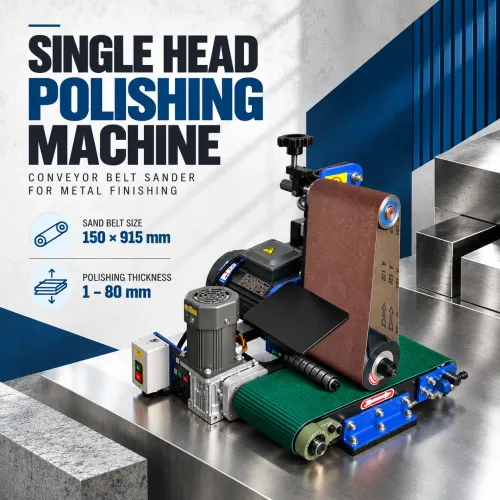
3. 150 × 915 mm Sanding Belts
The specified sanding belt size is 150 mm wide and 915 mm long per station. Each belt must meet the machine's dimensional, joint and operating speed requirements.
4. Polishing Thickness of 1- 80 mm
The machine supports a specified workpiece thickness range of 1- 80 mm, subject to the component dimensions and machine operating limits.
5. Maximum Polishing Width of Up to 140 mm
The maximum specified polishing width is up to 140 mm. Check the workpiece dimensions before processing to ensure compatibility with the machine's working area.
Technical Specifications
The main specifications of the double head polishing machine are:
- Machine Type: Double Stations
- Main Supply Voltage: 420 V, three-phase, 50 Hz
- Conveyor Supply Voltage: 220 V, single-phase, 50 Hz
- Main Motor Power: 2200 W × 2 (4400 W combined)
- Conveyor Motor Power: 120 W
- Combined Rated Motor Power: 4520 W
- Polishing Thickness: 1 - 80 mm
- Maximum Polishing Width: Up to 140 mm
- Sanding Belt Size: 915 × 150 mm per station
- Packing Dimensions: 1000 × 580 × 720 mm
- Gross Weight: 190 kg
Confirm the rated electrical supply, wiring and installation requirements before connecting the machine.
Applications of a Double Head Metal Polishing Machine
A double head conveyor belt sander is suitable for metalworking applications that require successive grinding and surface finishing.
Common applications include:
- Stainless steel fabrication: Grinding and conditioning compatible stainless steel components.
- Sheet metal processing: Smoothing and finishing suitable metal pieces.
- Metal furniture manufacturing: Preparing compatible components for further finishing.
- Engineering workshops: Processing repeat components through defined abrasive stages.
- Industrial component manufacturing: Combining initial grinding and surface refinement in one workflow.
Application suitability depends on the metal type, component dimensions, abrasive selection and required finish.
Benefits of Using a Double Head Conveyor Belt Sander
- Faster workflow: Two finishing operations can be performed in one machine setup.
- Reduced handling: Less movement between separate machines is required.
- Flexible surface finishing: Different compatible belts can be selected for each station.
- Improved production efficiency: Conveyor feeding supports repetitive processing.
- Repeatable results: Consistent machine settings and belt selection help maintain uniformity across similar components.
How to Choose the Right Abrasive Belts
Selecting the correct belts for both stations is essential for achieving the desired finish.
- Aluminium oxide abrasive belts: Commonly used for general-purpose grinding on compatible metals.
- Zirconia abrasive belts: Suitable for demanding grinding applications on compatible materials.
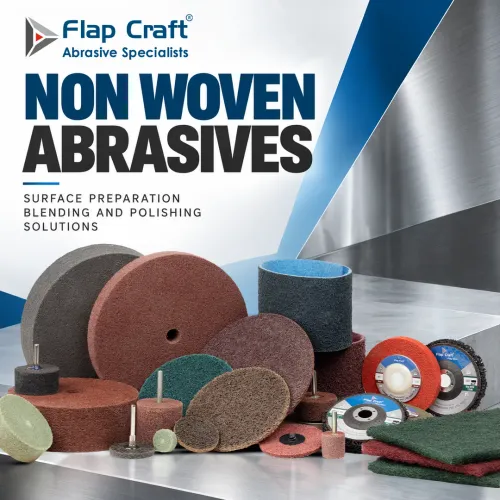
- Non-woven abrasive belts: Used for surface conditioning, scratch refinement and finishing.
A practical configuration is to use an abrasive belt for initial grinding at the first station and a non-woven abrasive belt for finishing at the second. Test the combination on representative workpieces to determine the appropriate belt grades and conveyor speed.
Always verify belt dimensions, joint compatibility and operating speed ratings before installation.
Safety and Maintenance
Proper maintenance helps maintain finishing quality and supports safe operation.
- Inspect both belts for wear, damage and correct tracking.
- Keep guards and protective devices in place.
- Keep hands and loose clothing away from moving belts, rollers and conveyor nip points.
- Use suitable eye, hearing and respiratory protection.
- Provide appropriate dust extraction where required.
- Isolate the electrical supply before belt replacement or maintenance.
Operators should follow the manufacturer's instructions for belt tension, tracking and routine maintenance.
Frequently Asked Questions
1. What is a double head polishing machine?
It is an industrial metal finishing machine with two polishing stations and a conveyor system for processing compatible workpieces through successive abrasive operations.
2. Can two different abrasive belts be used?
Yes. The machine can be configured with two different compatible belts. For example, an abrasive belt can perform initial grinding while a non-woven abrasive belt handles surface conditioning and finishing.
3. How does a double head machine reduce processing time?
It combines two finishing stages in one machine setup, reducing the need to transfer components between separate machines.
4. What is the sanding belt size?
The specified belt size is 150 × 915 mm per station.
5. What is the polishing thickness range?
The specified polishing thickness range is 1–80 mm.
6. What is the maximum polishing width?
The machine supports a maximum specified polishing width of up to 140 mm.
7. What is the total motor power?
The two main motors provide 4400 W combined, and the conveyor motor adds 120 W, giving a combined rated motor power of 4520 W.
8. What are the packing dimensions and gross weight?
The packing dimensions are 1000 × 580 × 720 mm, and the gross weight is 190 kg.
Keywords