How to Choose the Right Abrasive Grit for Weld Blending
Weld blending is an important step in metal fabrication. Choosing the right abrasive grit helps manufacturers remove weld marks, improve surface quality, and reduce finishing time. However, the right abrasive product is equally important.
Abrasive Belt vs Flap Wheel: Where Should You Use Each?
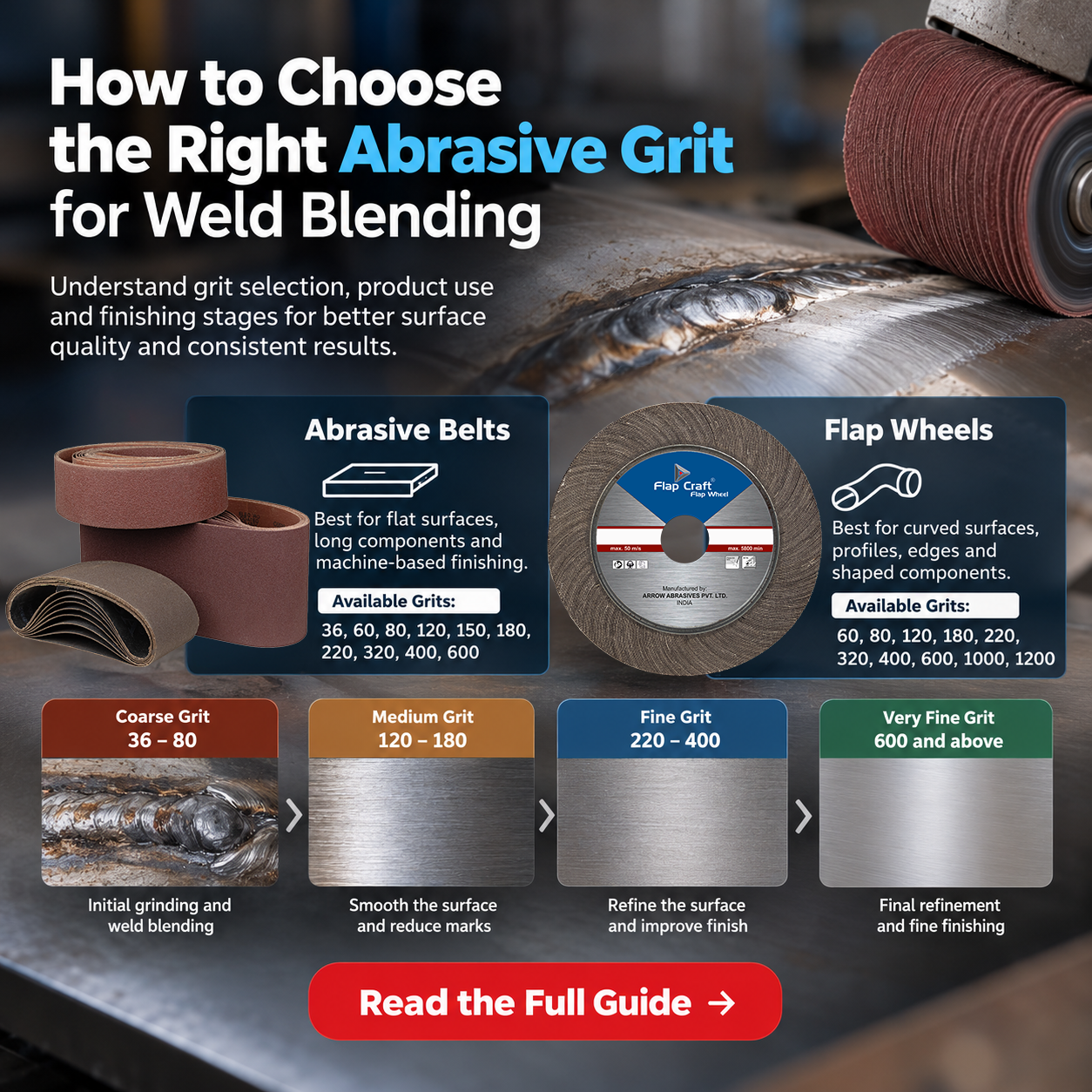
Abrasive belts are generally suitable for flat surfaces, long metal components, and machine-based production where consistent grinding and finishing are required.
Flap wheels are better suited to many curved surfaces, profiles, edges, and shaped components where controlled blending and uniform finishing are important.
The best choice depends on the component, machine, abrasive construction, and required finish.
Understanding Abrasive Grit Categories
Lower grit numbers generally indicate coarser abrasives, while higher numbers indicate finer abrasives. The following categories are practical guidelines for selecting grit according to the finishing stage.
1. Coarse Grit: 36-80
Available: Abrasive belts - 36, 60, 80. Flap wheels - 60, 80.
Coarse grits are used for initial grinding, removing surface irregularities, and blending weld marks where more material removal is required.
- Suitable for initial grinding and weld blending.
- Useful for preparing metal surfaces for subsequent finishing.
- Can remove material faster but may leave deeper scratches.
For heavy weld beads, a dedicated grinding operation may be required before using a flap wheel.
2. Medium Grit: 120-180
Available: Abrasive belts - 120, 150, 180. Flap wheels - 120, 180.
Medium grits are used after the initial grinding stage to smooth the surface and reduce marks left by coarser abrasives.
- Suitable for general surface blending.
- Helps reduce visible grinding scratches.
- Useful for preparing components for finer finishing.
These grits are commonly considered for metal fabrication and stainless steel finishing applications.
3. Fine Grit: 220-400
Available: Abrasive belts - 220, 320, 400. Flap wheels - 220, 320, 400.
Fine grits are suitable when the main grinding work is complete and a smoother, more uniform surface is required.
- Helps reduce finer scratches.
- Improves surface appearance.
- Prepares components for further finishing or polishing.
These grits are useful for components where the quality and consistency of the finished surface matter.
4. Very Fine Grit: 600 and Above
Available: Abrasive belts - 600. Flap wheels - 600, 1000, 1200.
Very fine grits are intended for final surface refinement and applications requiring a finer finish.
- Helps refine surfaces after earlier grinding stages.
- Suitable for certain fine-finishing and polishing-related processes.
- Can improve surface uniformity when used with the appropriate product and technique.
Grits 1000 and 1200 are available in the flap wheel range only. They are not intended for heavy weld removal.
Tips for Choosing the Right Grit
- Start with a suitable coarse grit when material removal is necessary.
- Move to medium and fine grits to reduce scratches and improve the finish.
- Choose abrasive belts for suitable flat or continuous surfaces and flap wheels for contours and profiles.
- Consider the base material, machine compatibility, operating pressure, and required surface finish.
- Test the selected grit sequence on the actual component to establish the best balance between finishing quality and production speed.
Technical note: These grit categories are practical groupings for the article, not universal industry standards. Actual performance and finish depend on the abrasive product, material, and operating conditions.
Looking for the Right Abrasive for Your Application?
Choose Flap Craft for abrasive belts and flap wheels designed for industrial grinding, weld blending, and surface finishing. Contact our team to discuss your application and find the right abrasive solution for your production needs.
Contact Flap Craft today to explore our abrasive range and get in touch with our team for product enquiries.
Keywords